
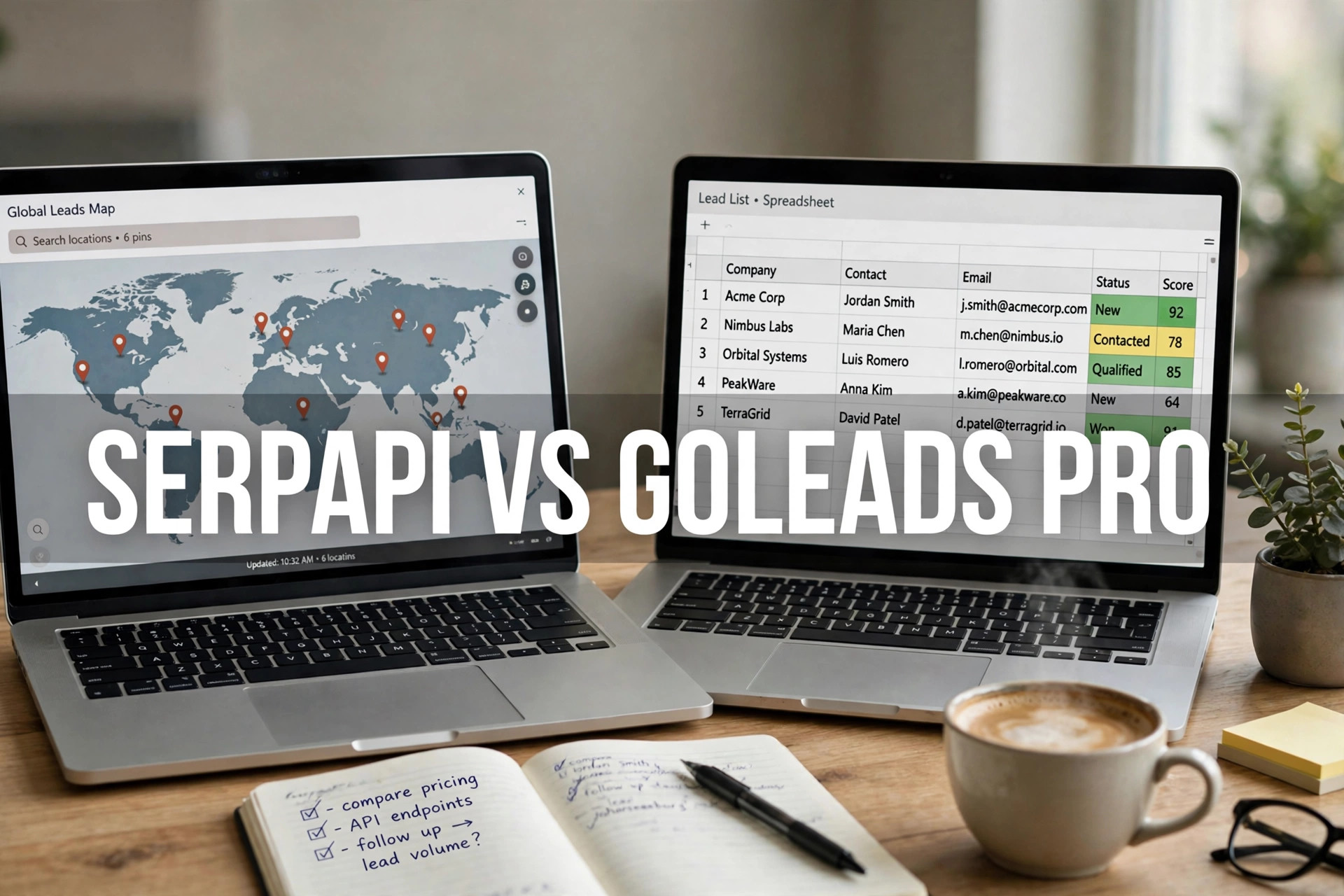
Short answer: the best SerpApi alternative for most lead buyers is GoLeads Pro when you want a Chrome extension, MX-checked emails, and a free start with no card, per the vendor. SerpApi still wins when you need fast listings, local-pack and SERP data, a developer API, and an uptime SLA.
I opened SerpApi expecting a Maps lead tool. I found an API company that happens to cover Maps. One tool asked me to write code before I saw a single usable lead. The other let me run a small search from inside Chrome and check the rows.
Name the job first. For the wider roundup, see our best Google Maps scraper roundup.
What is SerpApi, in plain words?
SerpApi is an API-first company that returns search results as structured JSON. You send a query, it fetches the results page, parses it, and hands back clean JSON. Its own Maps guide lists the same shape of work: place results, ratings, reviews, hours, phone numbers, coordinates, and photos.
Maps is one engine among many. SerpApi covers Google, Bing, Amazon, YouTube, and other search engines from the same API, per its own pages. That breadth is the product: rank data, ads, local-pack data, and Maps listings from one vendor.
SerpApi is API only. There is no dashboard where a non-developer picks a category, picks a town, and exports a list. You write code, you pass your access credential, you handle pagination, and you store the results yourself. Scrap.io puts it plainly: SerpApi is developer only, with no visual interface.
Where does SerpApi win?
First, SerpApi wins on speed. Lobstr.io gave it 10 out of 10 for speed and usability in its eight-API benchmark, and timed it at 9.0 and 9.9 seconds for 100 places. AIMultiple also names it the fastest provider in its five-API benchmark.
Second, SerpApi wins on SERP breadth. A Maps scraper gives you Maps listings. SerpApi gives you the Google search page itself: organic results, ads, the local pack, knowledge graph data, and shopping results.
Third, SerpApi wins on reliability terms. It publishes a 99.95 percent uptime SLA, per third-party reads, with service credits up to 100 percent of the monthly plan price.
SerpApi vs GoLeads Pro at a glance
| Point | SerpApi | GoLeads Pro |
|---|---|---|
| How it runs | API only, code required | Chrome extension plus dashboard, per the vendor |
| Start price, monthly | $25 a month, 1,000 searches, per third-party reads | $10 a month, 50,000 leads, Professional, per the vendor |
| Free start | 250 searches a month, free plan | 50 leads a day, 300 total, no card, per the vendor |
| Maps fields per place | About 15 to 20, per Scrap.io; 30 in the AIMultiple count; 41 in the Lobstr.io count | Listing fields plus website crawl, per the vendor |
| Emails | None, per Scrap.io and SerpApi own Maps guide | Website crawl, MX-checked, per the vendor |
| Results per search | About 20, per Scrap.io and AIMultiple | Near 120 per Maps search |
| Uptime SLA | 99.95 percent, up to 99.97 percent on higher tiers | Not published, per the vendor pages used here |
| API | The whole product | On the Business plan, per the vendor |
What does SerpApi cost per search, and what does that buy?
SerpApi sells searches, not records. Third-party reviewers read its pricing page in 2026 as Free at 0 dollars for 250 searches a month, Starter at 25 dollars for 1,000, Developer at 75 dollars for 5,000, Production at 150 dollars for 15,000, and Big Data at 275 dollars for 30,000: 2.5, 1.5, 1.0, and about 0.92 cents a search.
A search is not a lead. Each Maps search returns about 20 businesses, per Scrap.io and AIMultiple. Starter gives up to 20,000 raw listings, at 1.25 dollars per 1,000. Developer gives up to 100,000, at 0.75 dollars per 1,000. That is my own arithmetic, not a vendor quote.
Lobstr.io priced the same question at scale and put SerpApi at 0.36 dollars per 1,000 places, with a data score of 2.7 out of 10 and an overall score of 2.0 out of 10: listings only, with duplicates. Its dentist run found 4 to 5 percent duplicates across pages.
GoLeads Pro, per the vendor, runs Professional at 10 dollars a month for 50,000 leads, and Business at 20 dollars a month for 100,000, both at 0.0002 dollars a lead. That is a lead price, and the lead carries a crawled email with an MX check. See our cost per record guide.
What fields do you actually get?
SerpApi own Maps guide lists what a place result carries: title, GPS coordinates, rating, review count, price, type, address, operating hours, phone, website, description, order online links, photos, and reviews. No email field appears in that list. Scrap.io counts the same record at around 15 to 20 fields, and says SerpApi does not visit the business website or add social profiles.
Two independent benchmarks counted more fields, and the counts differ because the methods differ. AIMultiple counted 30 fields per place on average for SerpApi, against 71 for Apify, using Place Results for 1,000 businesses. Lobstr.io counted 41 fields in its dentist run. All three agree on the shape: a listing record, plus hours, ratings, and booking links, with no email and no website crawl.
GoLeads Pro pulls listing fields from a Maps search, then crawls each business website for published emails and social profiles, per the vendor. It does not publish a field count, and I will not invent one. See our API versus scraper guide.
How does email checking compare?
SerpApi does not extract emails. Scrap.io states it in one line: zero email extraction. SerpApi own Maps guide backs that up by omission, since no email field appears in its place result list. If you want to mail the businesses you pulled, you need a separate email tool and a merge step that matches emails back to listings.
GoLeads Pro runs an MX check on each address before export, per the vendor. An MX check asks the domain mail server whether the domain can receive mail. It catches dead domains and typo domains before they reach your list. It does not catch a full inbox or a spam trap. Treat the MX check as a filter, not a guarantee.
How do the two tools install and run?
SerpApi runs through code. You sign up, take an access credential, and call the API from Python, JavaScript, or any language that sends HTTP requests. Its own Maps guide walks through the same route: a no-code playground to test a query, then code to run it for real. The free plan gives 250 searches a month at 50 searches an hour, per third-party reads.
GoLeads Pro installs as a Chrome extension, with a web dashboard beside it, per the vendor. You run a Maps search in Chrome, pull the listings you see, and the dashboard holds the haul for your team. The free tier needs no credit card, per the vendor. One Maps search tops out near 120 results.
What happened in the Google case against SerpApi?
Google filed suit against SerpApi on December 19, 2025, in the United States District Court for the Northern District of California, case 4:25-cv-10826-YGR, before Chief Judge Yvonne Gonzalez Rogers. The complaint brought DMCA claims tied to SearchGuard, the system Google runs to stop automated scraping of search results.
On July 20, 2026, the court granted SerpApi motion to dismiss the DMCA claims, in Document 42. Claims covering search results with no copyrighted content were dismissed without leave to amend. Claims covering results with a copyrighted component inside a Knowledge Panel were dismissed with leave to amend.
Google filed an amended complaint on August 10, 2026, in Document 45, built on Reddit licensing terms, per PPC Land coverage. On September 15, 2026, the court denied SerpApi motion to compel production of Google licensing agreements, in Document 57, which recites the July 20 dismissal and the August 10 amended complaint. The case was live as of that order. I am not a lawyer, and this is a record of what the court papers say.
Scrap.io post says the dismissal came on July 21, 2026, and that the case was still pending with no ruling as of its mid-2026 writing. The court record says July 20, 2026, and Google had already refiled by August 10, 2026. I used the court record for the dates here.
Five mistakes that waste money when you shop for a SerpApi alternative
Mistake one: price per search is not price per lead
A search is not a lead. Starter costs 25 dollars for 1,000 searches, and each search returns about 20 listings with no email. Fix it by converting both prices to cost per mailed lead, after the email step.
Mistake two: SERP breadth bought for a Maps job
SerpApi covers Google, Bing, Amazon, and YouTube. That breadth is wasted money when your job is dentists in one city. Fix it by writing down the engines you will call before you pay.
Mistake three: a field count with no field list
Thirty fields, 41 fields, and around 15 to 20 fields are all reported for SerpApi, and all three describe the same listing record. Fix it by opening a sample response and circling the fields your CRM maps.
Mistake four: the email step forgotten until after payment
SerpApi returns no emails, so the list you paid for cannot be mailed until you buy a second tool. Fix it by pricing the email tool and the merge time before you buy.
Mistake five: an API tool for a team that does not write code
SerpApi is API only, and a non-developer team will stall at the first pagination loop. Fix it by naming the person who will write the code before you sign up.
A worked example: dentists in Miami, run both ways
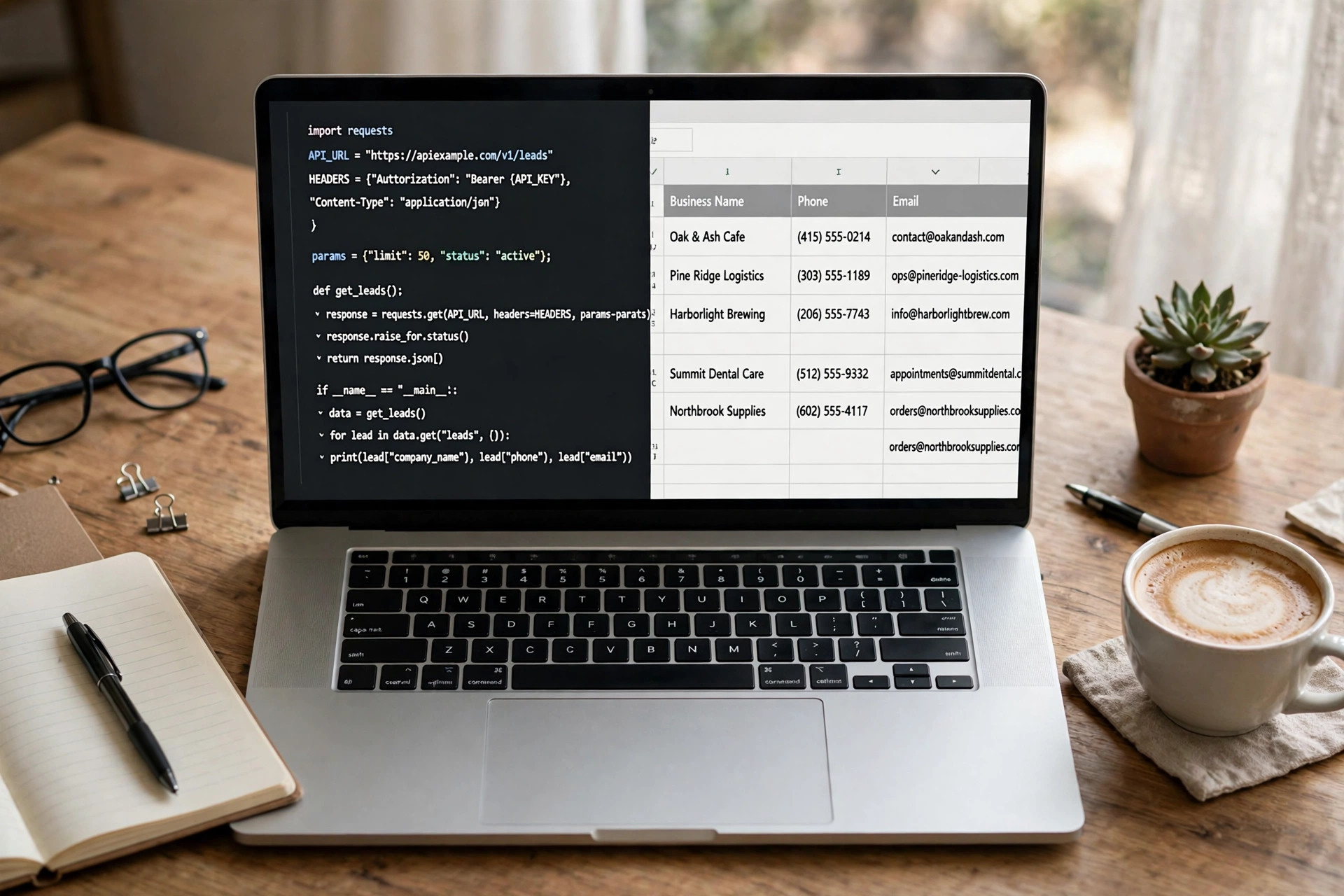
Say you search dentists in Miami. A browser extension pull tops out near 120 results for one search, so you split Miami by neighborhood: Coral Gables and Brickell. On SerpApi, the same job takes API calls at about 20 listings per search, so 120 listings take six searches.
Next, get the emails. On SerpApi, you have none yet, so you send each website through a separate email tool and match the addresses back to the listings. On GoLeads Pro, the extension crawls each website for emails, per the vendor, with an MX check before export. Sort generic rows from named rows, send a small batch, and read the bounce rate.
Copy this checklist before you switch
- Write down your monthly lead count in mailed leads, not searches.
- Open a sample SerpApi response and circle the fields your CRM maps.
- Price the email tool and merge time before you buy.
- Run one search in your market on each tool and check ten rows.
- Honor every opt-out at once, and mail only published addresses.
Which tool fits which buyer?
Pick SerpApi when you are a developer, you need SERP data across engines, you need fast listings with an uptime SLA, and you already have an email step or you do not need emails at all. Lobstr.io agrees: SerpApi is best for fast listings with an uptime SLA.
Pick GoLeads Pro when you pull smaller lists, you want a Chrome extension and a shared dashboard, and you want MX-checked emails with a free start and no card, per the vendor. For a closer Maps-first rival, see our Scrap.io alternative comparison.
Frequently asked questions
What is the best SerpApi alternative?
For most lead buyers, GoLeads Pro. It pairs a Chrome extension with a shared dashboard, crawls business websites for emails, MX-checks each address before export, and maps exports for HubSpot, Salesforce, Apollo, Pipedrive, and Zoho, per the vendor. It gives 50 free leads a day, 300 total, with no credit card.
Is SerpApi free?
SerpApi has a free plan with 250 searches a month at 50 searches an hour, per third-party reads. Paid plans start at 25 dollars a month for 1,000 searches. Check the live pricing page before you buy, and note that cached, errored, and failed searches do not count toward the limit.
How much does SerpApi cost per search?
Starter runs 25 dollars a month for 1,000 searches, or 2.5 cents a search, per third-party reads. Developer runs 75 dollars for 5,000 searches, or 1.5 cents a search. Production runs 150 dollars for 15,000 searches, or 1.0 cent a search. Big Data runs 275 dollars for 30,000 searches, or about 0.92 cents a search.
Where does SerpApi win over GoLeads Pro?
SerpApi wins on speed, SERP breadth, reliability terms, and developer fit. Lobstr.io gave it 10 out of 10 for speed and usability, and AIMultiple also names it the fastest provider. It returns organic results, ads, local-pack data, and Maps listings from one API, with a 99.95 percent uptime SLA.
Where does GoLeads Pro win over SerpApi?
GoLeads Pro wins on emails, price per lead, and the free start. Professional runs 10 dollars a month for 50,000 leads, per the vendor, against 25 dollars a month for 1,000 searches on SerpApi Starter, per third-party reads. It crawls websites for emails and MX-checks each address.
Does SerpApi extract emails from Google Maps?
No. SerpApi returns name, address, phone, rating, review count, hours, website, and coordinates, per its own Maps guide, and no email field appears in that list. Scrap.io states the same point directly: zero email extraction. You need a separate email tool to mail the listings SerpApi returns.
Does SerpApi have an uptime SLA?
Yes. SerpApi publishes a 99.95 percent uptime SLA, per third-party reads, with service credits up to 100 percent of the monthly plan price. Its pricing page cites SLAs up to 99.97 percent on higher tiers. GoLeads Pro does not publish an uptime SLA on the vendor pages used here.
Should I switch from SerpApi to GoLeads Pro?
Switch when the job is a checked list at a low flat price, not SERP data at speed. Move when you pull smaller lists, you want a Chrome extension with MX-checked emails, and 10 dollars a month for 50,000 leads, per the vendor, beats 25 dollars a month for 1,000 searches. Stay with SerpApi when you need multi-engine SERP data.
Run one search in your own market before you pay anyone. Claim the free GoLeads Pro credits from the pricing page, pull one trade in one town, and check ten rows against the live businesses.