
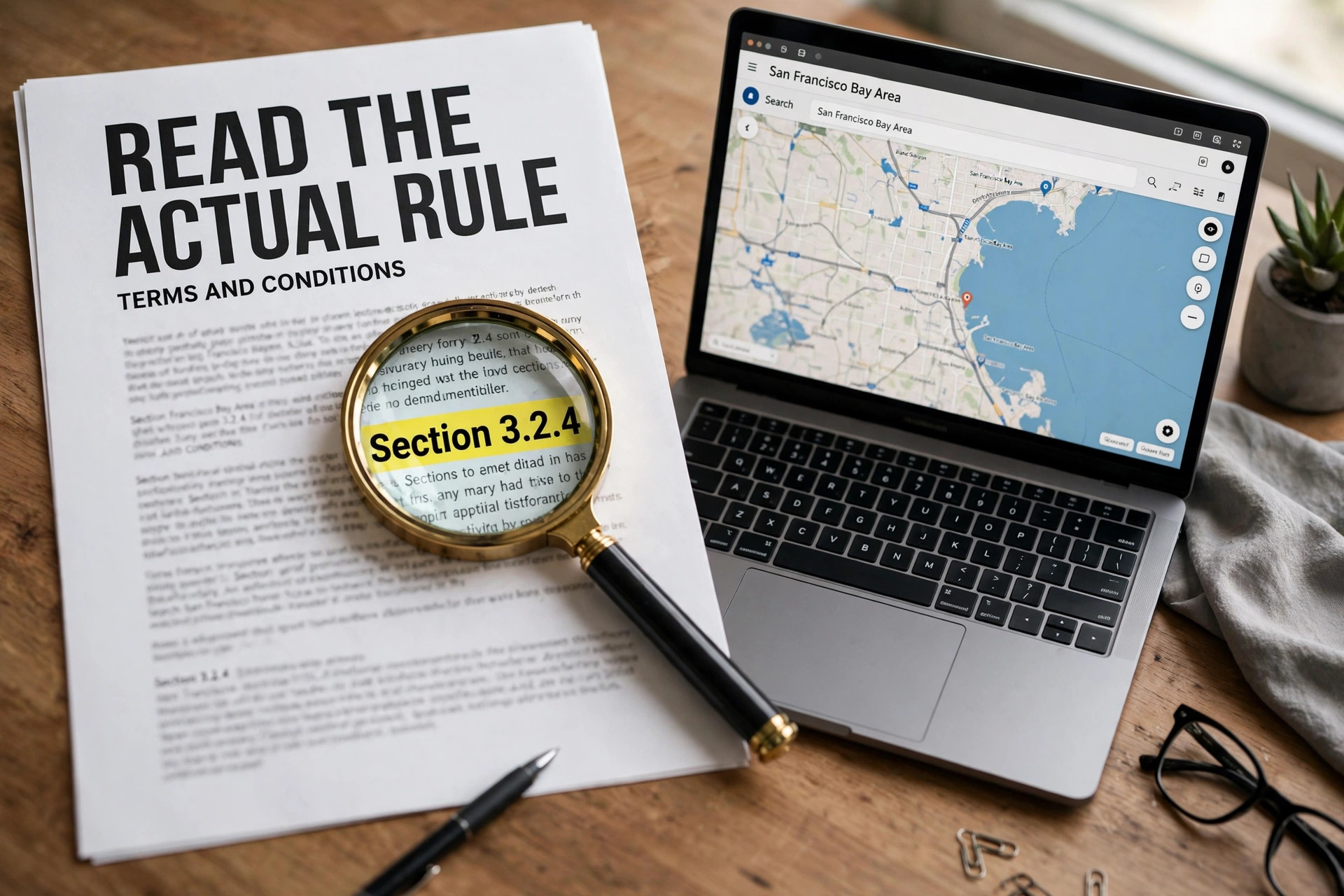
I read Section 3.2.4 before I run any pull. It bars customers from extracting, exporting, scraping, or caching Google Maps Content for use outside the Services, including copying business names, addresses, and reviews. A terms breach is a contract matter, and it is separate from whether scraping breaks the law.
What does Section 3.2.4 actually say?
Section 3.2.4(a) of the Google Maps Platform Terms, headed "No Scraping," reads as follows.
"Customer will not extract, export, scrape, or cache Google Maps Content for use outside the Services."
Google Maps Content is the clause's term for the data Google serves through Maps. The version I quote is the July 19, 2018 version, hosted at Google's terms URL. Google can amend the agreement, and material changes take effect 30 days after notice under Section 1.6.2, so I check the current version before I rely on any clause.
Guides cite different section numbers for this ban because Google renumbers the terms between versions. I quote the July 2018 text, where the ban sits at 3.2.4(a). Search the clause text, not just the number.
The clause then names four acts: pre-fetching, indexing, storing, resharing, or rehosting Maps content outside the services; bulk geocode downloads, meaning coordinate pairs pulled in volume; copying business names, addresses, or user reviews; and using Maps content with text-to-speech services.
Two more paragraphs sit beside it. Section 3.2.4(b) bars creating content based on Maps content, including tracing, digitizing, or building other datasets from it. Section 3.2.4(c) bars re-creating a Google product or feature, including listings, directory, or advertising-product uses of the Core Services.
Who does the clause bind, and who does it not bind?
The clause binds the Customer under the Google Maps Platform License Agreement: the entity or person who accepts the terms.
Section 3.2 states the rule plainly: "Customer will not" means the Customer will not do the act and will not permit a third party to do it. A team that hands extraction to a vendor still answers for the account.
Three layers exist. Platform customers answer under the Platform Terms. Everyday Maps users answer under the Google Maps/Google Earth Additional Terms, which customers must cite in their end-user terms. Google's general terms add a third layer, banning automated means of access (Leads Sniper's guide cites Section 5.3).
What I watch for here is the login question. Lobstr's FAQ states it directly: scraping public pages logged out means no contract binds you. ScrapeHero reports the same line from Meta v. Bright Data in 2024: terms cannot bar scraping data visible to unauthenticated users. I do not treat that as a free pass. Google can block the traffic.
The four named examples, in plain words
The four examples turn a broad ban into acts I can recognize in my own workflow.
| What the clause names | Plain meaning | Where I meet it |
|---|---|---|
| Pre-fetch, index, store, reshare, rehost Maps content outside the services | Holding a Maps copy on your own servers, or passing it on | A stored Maps list kept outside Google's services |
| Bulk download geocodes | Pulling coordinate pairs in volume | A batch job converting addresses to coordinates |
| Copy business names, addresses, user reviews | Lifting listing fields or reviews into your own file | Copying a listing's name, address, or reviews to a spreadsheet |
| Use Maps content with text-to-speech services | Reading Maps content aloud | A voice tool reading Maps listings |
Caching is not a blanket ban. Caching means storing a copy for reuse. The clause closes with a carve-out: caching is permitted for certain Services as described in the Maps Service Specific Terms. The ban turns on where the cached content sits.
Does breaking the clause mean breaking the law?
This is the first question people ask, and it tops every FAQ I checked while researching this post. The short answer is no. A terms breach is a contract matter. A crime is a different matter, and courts have kept the two apart.
The ruling teams cite most is hiQ Labs v. LinkedIn. In 2022, the Ninth Circuit held that scraping data open to the public does not violate the Computer Fraud and Abuse Act, the main US federal law on computer access. The Supreme Court had already narrowed the same statute in Van Buren in 2021, and the line runs through Meta v. Bright Data in 2024, per ScrapeHero's analysis.
That ruling does not erase the clause: Google can act on the account.
The companion post on whether scraping Google Maps is legal covers the court rulings plus GDPR, CCPA, and CAN-SPAM duties.
What actually happens when Google catches you?
Two questions dominate this research: can I get banned, and can Google sue me.
Yes, you can get banned. Google detects scraping traffic and blocks it, and B2BLeadFinder notes that bans can cover an IP address or a whole server range. Logged-in accounts risk suspension; logged-out scrapers run into blocks and throttling.
What I watch for is an early warning pattern: CAPTCHA human checks showing up more often, then pages loading slower, then requests failing outright. I treat a challenge page as a stop sign and slow down or move it to the API. Pushing through with a solver or a fresh exit only raises the risk, a point the proxymint guide makes.
ScrapeHero's analysis ranks the outcomes this way: a temporary IP ban is high likelihood and low severity, account suspension is medium likelihood if logged in, a cease-and-desist letter is low likelihood for small-scale use, and civil litigation is low likelihood, tied to large-scale work.
How I work within the clause
I start with the licensed route and keep raw Maps content inside the services:
- I start with the Places API when the job fits it. The Places API is Google's official developer interface for Maps business data. Scraping parses Maps pages with a browser. The API returns the same kind of business data in a structured form under a license.
- I read contact details from the business's own website. An address a business publishes on its contact page is not Google Maps Content. GoLeads Pro works this way: the extension reads listing fields from a Maps search, then crawls each business website for published emails and runs an MX check, which asks the mail server if the address can receive mail.
- I never reshare, rehost, or republish raw Maps content.
- I leave review text and reviewer names out of exports. The clause names copying user reviews, and reviewer names carry GDPR duties of their own.
- I do not build a listings service or ad product on the Core Services, per Section 3.2.4(c).
- I record where each field came from. A source note turns a dispute about one record into a one-minute answer.
- I run outreach under the rules of each market I mail: CAN-SPAM in the US, GDPR legitimate interest in the EU, with a working opt-out in every message. The companion legal post covers both.
The API route has limits of its own. ScrapeHero notes a 5-review cap, 20 results per Nearby Search, a 30-day storage restriction, and per-service billing that scales fast at volume. Bettersheets, reading the terms in October 2026, found Place IDs storable indefinitely and latitude and longitude for up to 30 days, with no exception found for other Places content.
Say you search dentists in Miami and the list stops near 120 results. That cap is a platform limit, not a bug in your tool, per Prospeo's FAQ. I narrow the search by neighborhood or ZIP code rather than pushing the same query harder.
This article reads the clause. It does not certify any browser tool as compliant, and teams using one should weigh the account risk.
GoLeads Pro pairs a Chrome extension with a web dashboard. Free credits cover 50 leads a day and 300 in total, with no credit card at signup, and the free GMB lead extractor guide walks through a full first run. The company reports bounce rates under 3% on verified exports, against a 12-15% average for purchased lists, and 98% of phone numbers verified; both figures are vendor-reported. Exports land in CSV, XLSX, and JSON mapped for HubSpot, Salesforce, and Apollo, with duplicates merged across multi-location scans. Paid tiers reach 50,000 and 100,000 leads a month; the free vs paid page lays out the split. The GMB scraper, Maps lead extractor, and extensions roundup guides cover the listing side, the workflow, and the tool comparison.
A browser tool does not fit every job. A team that needs a standing copy of Maps data outside Google's services should use the licensed API route or drop that requirement. A team that needs named personal contacts should look elsewhere: Maps lists businesses, not org charts.
Section 3.2.4 worksheet: the check I run before I pull
I run this check before I pull. Any failed row means the method changes first.
| Check | Pass looks like | Stop if |
|---|---|---|
| Field source | Each field traces to the API license or a business site | Any field exists only from a copied Maps page |
| Storage | Maps content stays inside the licensed service | A stored Maps copy sits outside the services |
| Reviews | No review text or reviewer names leave | Review text or names appear in the export |
| Reshare | Nothing from Maps is reshared | A page or file republishes Maps records |
| Product shape | Your product adds value beyond Maps | A listings or ad product built on Core Services |
| Outreach | Unsubscribe and opt-out ready before send | No unsubscribe, no suppression list |
This page is legal information, not legal advice. Terms change, and a team that scrapes at scale or sells into regulated markets should have counsel review the process before launch.
Frequently asked questions
Does scraping Google Maps violate Google's Terms of Service?
Yes, on the Platform Terms. Section 3.2.4(a) bars extracting, exporting, scraping, or caching Maps content for use outside the Services, and the general terms ban automated means. A breach is a contract matter, not a crime. One nuance matters: Lobstr notes that scraping public pages logged out means no contract binds you, and Meta v. Bright Data (2024) held that terms cannot bar scraping data visible to unauthenticated users.
Can Google sue me for scraping Maps data?
Unlikely for small-scale use. Google's enforcement runs through technical measures first: CAPTCHAs, rate limits, IP throttling, and account suspension. When Google sued SerpApi in December 2025, per Lobstr's reporting, it did not plead breach of contract, and the court dismissed the DMCA theory in July 2026. Risk rises with volume and with bypassing technical controls.
Can I get banned for scraping Google Maps?
Yes. Google detects scraping traffic and blocks it, and B2BLeadFinder notes that bans can cover an IP address or a whole server range. Logged-in accounts risk suspension; logged-out scrapers run into blocks and throttling. Pushing through with a solver or a fresh exit only raises the risk.
Does the clause ban all caching?
No. The clause closes with a carve-out: caching is permitted for certain Services as described in the Maps Service Specific Terms. The ban turns on where the cached content sits. Caching inside the licensed service is allowed. Holding Maps content outside the services, or resharing it from your own servers, is the act the clause bars.
Can I get emails from Google Maps?
Not from the listing itself. Google Maps listings do not display email addresses, so no tool pulls them from the listing. I get emails a second way: the crawl visits the business website and reads addresses the business publishes there, then runs an MX check on each address. That website step turns a listing pull into an outreach list.
Start with one search in your own market. Open a free GoLeads Pro account, run one trade you sell to, and check the export against the worksheet. Fifty leads a day costs nothing and asks for no card.