
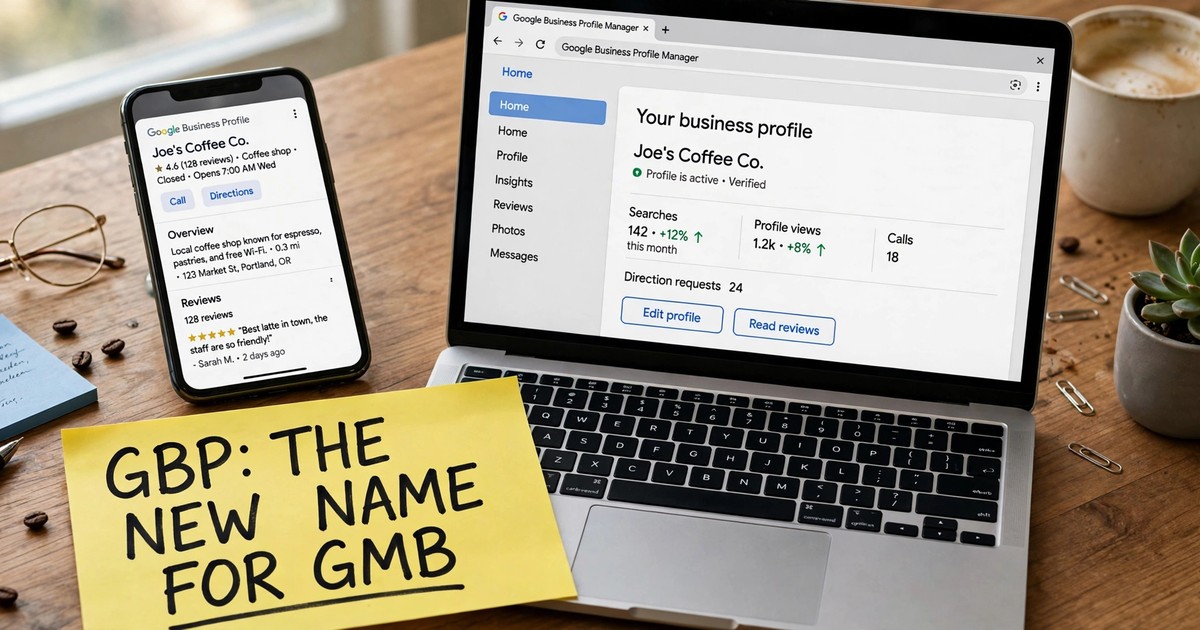
I run a GBP scraper when I need a list of local businesses. It reads Google Business Profile listings on Maps and Search and saves each one as a row of contact data. GBP is the new name for Google My Business, renamed on November 4, 2021. The listings stayed the same. The name and the management screens changed.
What changed when Google My Business became Google Business Profile?
I still open the same listings. What changed is the name and where I manage them.
On November 4, 2021, Google renamed Google My Business to Google Business Profile. Matt Madrigal, then Google's vice president and general manager for merchant shopping, said the rename was meant to keep things simple. I edit a single-location profile inside Search and Maps now. Larger operators work in Business Profile Manager, and the standalone GMB app left the app stores in 2022.
Buyers still type GMB scraper into search boxes, so vendors kept the old term in product names and page copy. I use GBP in my own notes and GMB when I match a buyer's search term. A google business scraper and a gmb scraper read the same listings. Our Google My Business scraper guide covers the listing side of the work in more depth.
What data do I pull from a GBP listing today?
I pull the public fields on the listing first, then I add emails and social profiles from the website.
The listing itself carries the business name, category, address, phone number, website, hours, star rating, and review count. Services the business lists on its profile show up too. A place ID is Google's unique ID for one listing. I use it to dedupe, which means removing repeat records.
| Field | Source | Typical availability |
|---|---|---|
| Business name | Listing | On every listing |
| Business category | Listing | On every listing |
| Street address | Listing | On nearly every listing |
| Phone number | Listing | On most listings |
| Website | Listing | On most listings |
| Star rating | Listing | Where reviews exist |
| Review count | Listing | Where reviews exist |
| Opening hours | Listing | On most listings |
| Services listed | Profile | Where the business lists them |
| Place ID | Listing | On every listing |
| Coordinates | Listing | On most listings |
| Email address | Business website | Where the business publishes one |
| Social profiles | Business website | Where the business links them |
The website rows decide the value of the list for cold email. A scrape without them still works for phone outreach. The Google Maps lead extractor guide walks through the website crawl and the checks that follow it.
How do I run a GBP scrape, start to finish?
I start with one trade and one town, and I finish with a file my CRM can import. CRM stands for customer relationship management.
- I create a free account and install the extension. I sign up, then I add the GoLeads Pro Chrome extension to my browser. The extension stays in sync with the web dashboard.
- I search Google Maps for a trade and a place. Say you search dentists in Miami. I scroll the results panel so the full list loads before I start.
- I run the extraction. I start the scrape from the extension. The tool records the public fields from each listing, then visits each business website to look for published emails and social profiles.
- I clean the list in the dashboard. Duplicates drop out, fields land in fixed columns, and I cut the list with filters: rating floor, review count, has a website, has an email.
- I export and import. I download the list as CSV, XLSX or JSON. The export maps to HubSpot, Salesforce and Apollo field layouts.
The free tier covers my early runs: 50 leads a day, 300 in total, no credit card at signup. Paid plans reach 50,000 and 100,000 leads a month. GoLeads Pro reports bounce rates under 3 percent on verified exports, against a 12 to 15 percent average for purchased lists, and 98 percent of phone numbers verified. I read those figures as vendor-reported numbers. The free GMB lead extractor guide walks through what the free tier returns, and the free vs paid page lays out the split.
Why do I only get part of the list from one search?
Maps shows a limited slice of results per search. I split the area and run each part.
Maps is built for a person looking for a nearby business. One search shows part of what exists in an area. Scrap.io's filtering guide makes a useful point here: the limit sits on what Maps displays per search. Scrupp's FAQ describes the same fix I use: split a city into smaller areas, such as neighborhoods or postcodes, run a search in each one, then dedupe by place ID.
What I watch for is overlap. Two nearby tiles return the same dentist twice. Dedupe by place ID catches that, because the ID stays the same even when the name spelling shifts. I check the count after dedupe, not before.
Why do so many rows have no email?
Most businesses never publish an email address. No tool can pull what the business never posted.
Prospeo's lead-scraping guide notes that only around 30 to 70 percent of small business websites publish an email address, and that email hit rates from raw Maps scrapes rarely pass 40 percent. That matches most lists I pull: plenty of rows carry a phone and a website, and fewer carry an address.
Three reasons sit behind the missing rows. Some businesses have no website at all, so there is no page to crawl. Some have a website with a contact form and no address on it. Some show an address only as an image, which a crawl cannot read as text. For cold email I filter to rows with an address and keep the phone rows for calling. I never guess addresses. A guessed address bounces, and bounces hurt the domain I send from.
For rows that do carry an address, I only mail MX-checked ones. An MX check asks the mail server whether the address can receive mail.
How is a GBP scraper different from an old GMB scraper?
For the person running a search, the difference is small. Three things moved under the surface.
Names moved first. Tool names, docs, and search terms now say GBP. Old guides, videos, and extension listings still say GMB. Both names point at the same public record.
Developer tools moved next. Google moved its business APIs from the old v4 My Business endpoints to v1 Business Profile endpoints, and closed the My Business Q&A API on November 3, 2025, per Google's own developer changelog. A scraper that once pulled questions and answers has no Q&A field to pull today. Before I buy an old tool, I check its update history and run one small search to confirm the fields still fill.
One more wrinkle I watch for: some review-focused extensions sit outside the Chrome Web Store, because Google's guidelines block review scraping extensions there. I check what data a sideloaded tool sends and where it goes before I install one.
What stayed put matters too. Listing fields, Maps search, and the website crawl for emails all work the way they did under the GMB name. Our roundup of the best GMB scraper Chrome extensions compares current tools field by field.
GBP scrape readiness worksheet
I run through this list before I spend credits.
- Search terms: the trade plus town pairs I will run
- Territory: postcodes or towns
- Category check: I read 20 results by hand first
- Rating floor: the minimum star rating I will accept
- Review floor: the minimum review count that signals a real business
- Website rule: rows with a site, rows without one, or both
- Email rule: MX-checked addresses only for cold email
- Dedupe: one record per business across all searches, matched on place ID
- Export format: CSV, XLSX, or JSON
- Freshness date: the run date on the file
- Opt-out handling: a suppression list in place before the first send
Read the guide to scraping Google Maps legality before the first campaign goes out.
When is a GBP scraper the wrong tool for me?
A GBP scraper returns businesses. It does not return named people.
I get the business, its phone, its website, its ratings, and any email it publishes. I do not get the owner's name, a job title, or a direct line to the person who signs contracts. For that job I use a contact database built for named people.
A business with no website offers no page to crawl, so its record stops at phone and address. A scrape also reflects the day I ran it. Businesses move, rebrand, and close, so I re-run the search before a large campaign.
A scraper reads public data. It cannot show me my own profile's private analytics or post performance. For my own profile I use Business Profile Manager. If I need licensed data inside a product, I use Google's Places API instead. Scrap.io's comparison notes it charges 32 to 40 dollars per 1,000 requests and caps results per query, so I use it for small licensed pulls and a scraper for bulk prospecting.
If the reason you are here is a switch from another tool, the Lead Sniper alternative comparison scores five options on pricing, emails, and exports.
Frequently asked questions
Is a GBP scraper the same as a GMB scraper?
Yes. They are the same tool under two names. Both read business listings on Google Maps and Search. Google renamed Google My Business to Google Business Profile on November 4, 2021, and the listings kept their place on Maps and in Search. Sellers still use GMB in product names because buyers still search with the old term. I judge a tool on the fields it returns and the checks it runs.
Can a GBP scraper pull email addresses?
Yes, with one condition I always keep in mind. Google Business Profile listings show no email field, so no tool pulls addresses from the listing itself. Scrapers that return emails visit the website on the listing and read addresses the business publishes on its contact page or footer. GoLeads Pro then runs an MX check on each address to confirm the mailbox accepts mail before export.
Is it legal to scrape Google Business Profile data?
For public business data, yes in most cases. US courts, led by hiQ Labs v. LinkedIn in the Ninth Circuit in 2022, have held that collecting data anyone can view does not violate the federal hacking law. Google's terms still bar automated access, so scraping sits outside the contract a user accepts. The practical cost is account action. Read the full legality guide before you build a workflow on scraped data.
Do old GMB tools still work?
Browser tools that read live listings keep working, because the listings never moved. Tools built on Google's retired developer endpoints are a different story: Google moved its business APIs from v4 My Business paths to v1 Business Profile paths, and closed the Q&A API on November 3, 2025. Before I buy an old tool, I check its update history and run one small search to confirm the fields still fill.
How much does a GBP scraper cost?
Prices differ by vendor and by volume. GoLeads Pro starts free: signup credits cover 50 leads a day and 300 in total, with no credit card asked for. Paid plans scale to 50,000 and 100,000 leads a month. I check the pricing page for current rates, and I weigh any plan against the cost of a bounced campaign on a burned domain.
Start with one search in your own market. Create a free GoLeads Pro account, run the extraction on a trade you sell to, and export the list. Fifty leads a day costs nothing, asks for no card, and shows you within one sitting whether GBP data fits your outreach.